
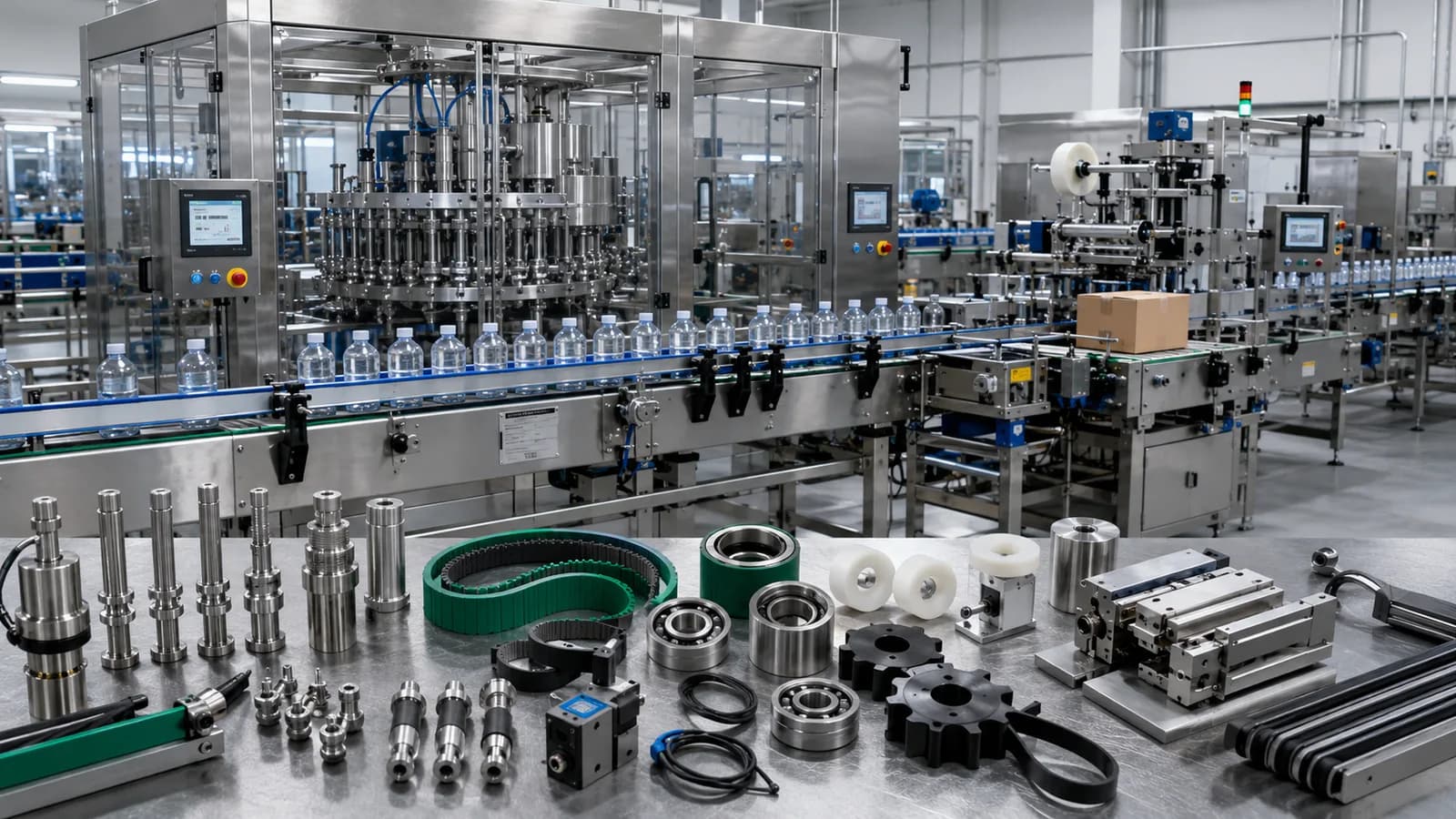
Packaging machine spare parts China: what buyers should verify first
Packaging machine spare parts China sourcing is not only a price search. A filling valve, sealing element, conveyor roller, sensor, belt, heater, motor, or pneumatic valve may look simple, but the wrong replacement can stop a production line, damage packaging quality, or create safety and integration problems.
For overseas factories and distributors, the first task is to identify the part correctly. The second task is to decide whether the buyer needs an exact OEM spare part, a compatible replacement, an aftermarket component, or a custom-made mechanical item. MAVORIX INDUSTRIAL supports Packaging Industry sourcing and industrial spare parts sourcing from China, but compatibility still depends on the machine, the component function, and the information provided by the buyer.
This guide is a procurement checklist, not a substitute for machine-specific engineering approval.
Why packaging machine replacement parts are hard to source correctly
Packaging lines often combine mechanical, electrical, pneumatic, heating, conveying, coding, and control-system components. Machine type alone is not enough. Two filling machines may use different valve assemblies, sensors, control voltages, filling nozzles, product-contact materials, or pneumatic layouts. Two sealing machines may use similar heaters but different wattage, mounting, thermocouple type, coating, length, or temperature control method.
Machine builders and packaging associations also emphasize spare parts planning and risk assessment. PMMI ProSource guidance on specifying packaging machinery recommends planning for spare parts and identifying common wear parts as part of machine specification work. That same logic applies when a buyer later sources replacements from China: the RFQ should describe the part, the machine, and the operating context.
Information buyers should prepare before sending an RFQ
Before asking for a quotation, collect a structured file. This is more useful than sending a single photo in a chat message.
| Information | Why it matters |
|---|---|
| Machine manufacturer, model, serial number and year | Helps identify the machine family and possible part variations |
| Packaging format and operating speed | Affects wear parts, sealing elements, guides, belts and timing components |
| Voltage, frequency and control voltage | Important for motors, heaters, sensors, valves, relays, drives and control parts |
| Pneumatic pressure and connection details | Needed for cylinders, solenoid valves, fittings and air preparation parts |
| Photos of the old part and installed position | Shows orientation, mounting, cable or hose routing and connection points |
| Nameplates, labels and markings | May show model, rating, material, sensor type, port size or wiring information |
| Drawings, dimensions or physical sample | Needed when model numbers are missing or custom parts are involved |
Packaging equipment categories where part details differ
Packaging spare parts sourcing may involve filling machines, sealing machines, labeling machines, conveyors, cartoners, bagging machines, wrapping machines, coding or marking equipment, and general packaging lines. This list is not exhaustive. Each machine category has different critical parameters.
For example, a conveyor spare part may depend on belt profile, width, pitch, roller diameter, shaft size, guide design, load and product type. A filling machine part may depend on liquid viscosity, filling volume, valve design, seal material, pump type and cleaning conditions. A coding-related part may require careful electrical and software confirmation rather than only visual matching.
Common packaging machine spare part categories
Common packaging equipment spare parts may include belts, chains, bearings, rollers, guides, sealing elements, heaters, temperature sensors, photoelectric sensors, proximity sensors, pneumatic cylinders, solenoid valves, fittings, motors, gearmotors, pumps, switches, relays, contactors, PLC/HMI/drive-related components, and general packaging line maintenance parts.
Buyers should use careful language in RFQs. Do not write only "need sealing part" or "need conveyor motor." Specify the function, location, model, dimensions, rating and operating conditions.
Exact replacement, compatible replacement or custom manufacturing?
| Option | Best use case | Key advantage | Main risk | Information required |
|---|---|---|---|---|
| Exact OEM part | Critical machine-specific part with clear original reference | Lowest uncertainty if available | Price, lead time or availability may be difficult | OEM part number, machine model, serial number |
| Compatible replacement | Standard electrical, mechanical or pneumatic component with confirmable specification | More supplier options | Hidden differences may affect fit or performance | Full parameters, photos, dimensions, application |
| Aftermarket part | Wear part or replacement item commonly supplied outside OEM channel | Useful when OEM support is slow or costly | Quality and compatibility must be checked | Sample, drawing, material, performance expectation |
| Custom manufacturing | Suitable mechanical item with drawing/sample and buyer approval | Can solve obsolete or non-standard mechanical needs | Not suitable for every component or safety-critical function | Drawing, material, tolerances, sample, inspection plan |
Critical parameters by component type
For motors and gearmotors, verify voltage, frequency, power, speed, mounting, frame size, shaft dimensions, gearbox ratio, duty/application, protection level where known, and whether the motor connects to a drive. Same power and voltage alone are not enough.
For sensors, verify sensing principle, sensing distance, supply voltage, output type, connector, cable length, mounting, environment and target material. A visually similar photoelectric sensor may still have different output logic or connector pinout.
For pneumatic valves, verify port size, valve function, pressure range, voltage, coil type, flow requirement, manual override, mounting and connector. A valve with the same shape can still have a different function.
For belts, verify profile, width, length, pitch, tooth form, material, tensioning method and application. Packaging line belts may also need food-contact or anti-static considerations depending on the line.
For heaters and temperature sensors, verify length, shape, wattage, voltage, mounting, connector, thermocouple or sensor type, and working temperature range.
Why control-system parts require extra care
PLC, HMI, drive, servo, coding controller and network-related components need more caution than simple mechanical parts. Software, firmware, parameters, communication protocol, I/O mapping, safety function and machine sequence can affect compatibility. A visually similar HMI or drive does not mean it can be installed without engineering work.
Buyers should not approve control-system replacements without confirming integration requirements. In some cases, the correct decision is OEM support, qualified engineering review, or a planned retrofit rather than a quick component swap.
RFQ checklist for packaging machinery spare parts supplier China searches
- Machine manufacturer, model, serial number and production year where available.
- Packaging format, product type, operating speed and line position.
- Old part photos from all sides and photos of the installed position.
- Nameplates, labels, markings, wiring, hose or port photos.
- Dimensions, mounting holes, shaft size, thread, connector and interface details.
- Voltage, frequency, control voltage, pneumatic pressure and working environment.
- Quantity, urgency, destination country and packing expectation.
- Whether exact OEM, compatible replacement, aftermarket part or custom manufacturing is acceptable.
- Whether engineering confirmation is required before purchase.
Quotation comparison checklist
| Quotation item | What to compare |
|---|---|
| Part identity | Exact OEM reference, compatible model, aftermarket item or custom-made part |
| Technical match | Dimensions, voltage, material, mounting, connector, pressure, speed or temperature |
| Included items | Main part, accessories, cables, fittings, seals, mounting hardware or documentation |
| Quality evidence | Photos, sample option, test report, inspection checklist or supplier explanation |
| Lead time | Stock, production time, sample time and packing time |
| Packing | Export packing, small-part labeling, carton marks and protection against damage |
| Supplier capability | Product focus, communication quality and willingness to confirm details |
Incoming inspection considerations
Incoming inspection should compare the delivered part against the approved specification, not only against the supplier invoice. Check quantity, labels, visible damage, dimensions, connectors, voltage markings, material or surface finish, packing condition and whether small parts are mixed or missing. For critical parts, keep sample records and installation feedback for future repeat orders.
For China-side checks before shipment, buyers can use quality inspection support and supplier verification when order value or line risk justifies it.
Key takeaways
- Machine type alone is not enough to identify packaging machine replacement parts.
- Visually similar parts may differ in voltage, output, mounting, material, pressure, software or function.
- Control-system parts need engineering confirmation because software, firmware and communication can matter.
- A good RFQ reduces wrong-part risk before suppliers quote.
- For mixed maintenance items, MRO sourcing from China can support small and repeated orders.
Soft next step
Send machine brand/model, part photos, nameplate, old part number, dimensions, quantity and destination country to MAVORIX INDUSTRIAL through the contact page. We can help review the sourcing path, compare supplier options and coordinate the next steps from China.
Email: michael@mavorixindustrial.com WhatsApp / Phone: +86-13967842747