
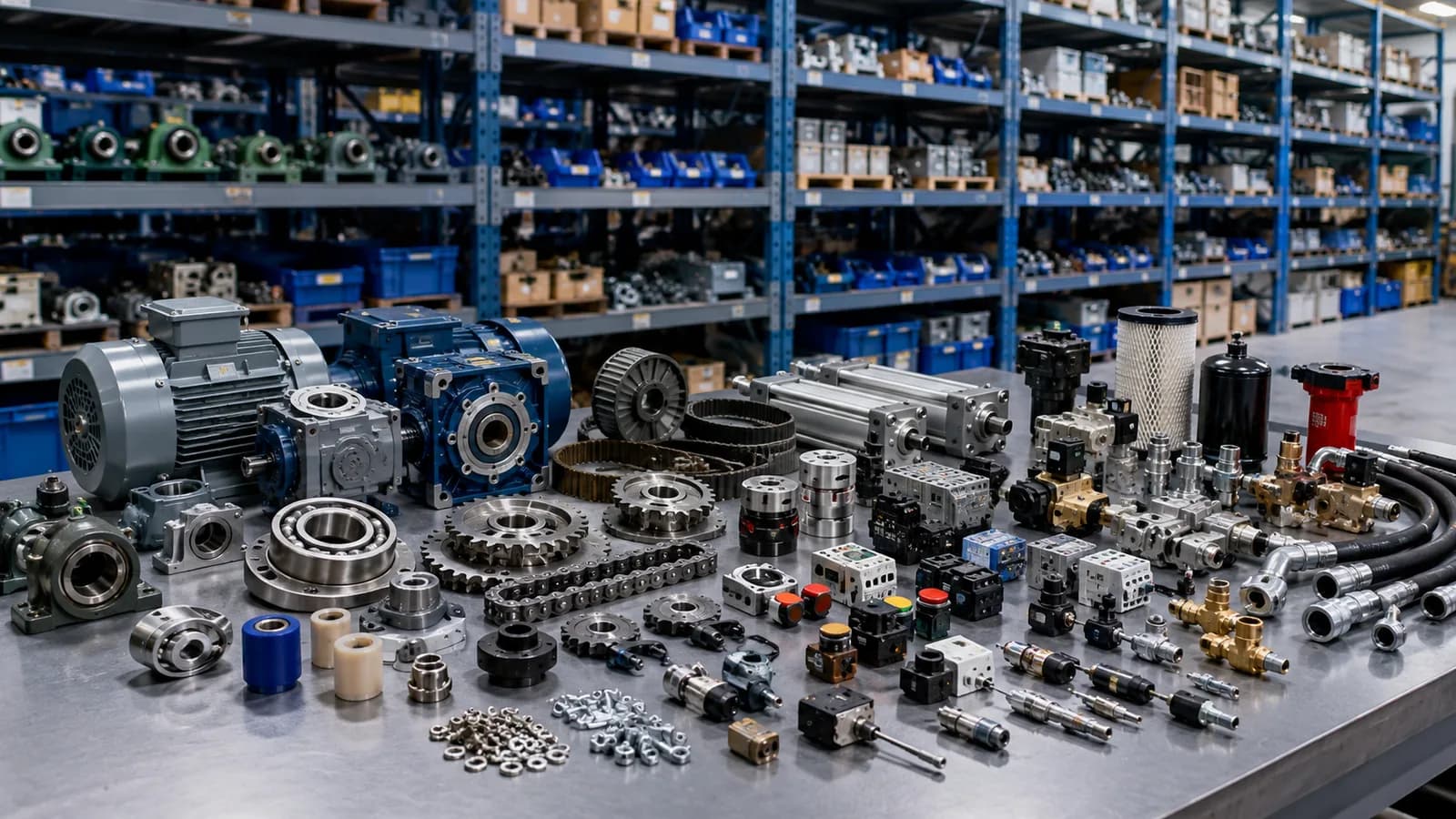
Industrial spare parts sourcing China when the part number is missing
Industrial spare parts sourcing China becomes more difficult when the buyer does not have a part number, drawing, or clear manufacturer reference. This is common with older machines, discontinued equipment, second-hand production lines, imported machines with missing manuals, or maintenance parts that were replaced several times without proper records.
A product name or one photo is rarely enough. A bearing housing, pneumatic cylinder, relay, belt, gearbox, heater, valve, sensor, bushing, coupling, seal, or electrical module may look similar to many alternatives. Compatibility depends on dimensions, interfaces, material, load, voltage, pressure, temperature, speed, mounting method, and the machine environment. For safety-critical parts, pressure-bearing parts, electrical protection devices, and load-bearing components, buyers should confirm with the machine manufacturer, qualified engineer, or responsible technical team when appropriate.
MAVORIX INDUSTRIAL supports overseas factories with industrial spare parts sourcing, but identification still depends on the information available. Photos can help, but they do not guarantee that every part can be identified or replaced safely.
Why spare parts are difficult to identify
Many industrial parts are not sold under a universal name. The same visible shape may be produced in different materials, tolerances, ratings, standards, and internal designs. Some parts are OEM-specific. Others are standard catalog parts with markings that have become worn, painted, damaged, or hidden after years of use.
The identification problem becomes harder when:
- The machine brand or model is unknown.
- The part number has been scratched, painted over, or removed.
- The part is obsolete or from a discontinued production line.
- A previous replacement was already a compatible alternative.
- The buyer only has a cropped photo without scale or installation context.
- Electrical, hydraulic, pneumatic, or safety functions are not clearly described.
What buyers should collect before requesting a quotation
Before asking suppliers to quote replacement parts without part number, prepare a structured information file. This is more useful than sending scattered chat messages.
| Information to collect | Why it matters |
|---|---|
| Clear photos of the part | Helps suppliers identify shape, material, connection points, and visible markings |
| Photos of the installed position | Shows how the part connects to the machine and nearby components |
| Machine brand, model, year, and serial number | Helps search manuals, exploded diagrams, BOMs, and matching machine families |
| Nameplates and markings | May reveal voltage, pressure, speed, load, thread, size, or manufacturer code |
| Main dimensions and interfaces | Prevents choosing a part that only looks similar |
| Operating environment | Temperature, liquid, dust, vibration, load, pressure, or chemical exposure may affect compatibility |
| Old invoices, manuals, drawings, or samples | Can confirm original specification or purchasing history |
How to photograph the part correctly
A useful photo set should include front, back, side, top, bottom, connector, thread, mounting hole, label, and damaged area views. Use good lighting, avoid blur, and clean the part only if doing so will not remove markings or evidence. Take one photo with a ruler or caliper beside the part, but do not rely on a photo scale alone for final dimensions.
For electrical and mechanical parts, photograph every label and terminal marking. For belts and chains, photograph printed codes, pitch, width, tooth profile, links, and any joint. For pneumatic and hydraulic parts, photograph ports, threads, stroke markings, pressure markings, seals, and mounting brackets.
Photograph the machine and installation position
Suppliers often need to know where the part is used. A close-up of a removed component may not show function. Take photos of:
- The complete machine from several sides.
- The machine nameplate.
- The part installed before removal, if possible.
- The surrounding assembly.
- Cable, hose, shaft, chain, belt, or bracket connections.
- Direction of movement, rotation, or flow.
Dimensions and interfaces to measure
The correct measurements depend on the part type, but buyers commonly need outside diameter, inside diameter, length, width, height, hole spacing, shaft diameter, keyway size, thread type, pitch, port size, stroke, mounting pattern, connector type, voltage, current, pressure rating, speed, and load.
For bearings, bushings, couplings, belts, chains, pneumatic cylinders, valves, filters, sensors, motors, and electrical components, the interface is often as important as the body size. A replacement can fail if the mounting hole, shaft fit, connector, seal, or thread is wrong.
Buyers should also record the measurement method. For example, a worn shaft, damaged thread, or compressed seal may not represent the original size. If the part has wear or deformation, measure several positions and explain which areas are damaged. When tolerance is important, a supplier may need a drawing, sample, or engineering confirmation instead of rough hand measurements.
Exact, compatible, or custom-made replacement
Buyers should decide which replacement path is acceptable.
| Replacement type | Meaning | Main risk |
|---|---|---|
| Exact replacement | Same original part number and specification | May be unavailable, obsolete, or expensive |
| Compatible replacement | Different brand or model that matches required function and interface | Compatibility must be confirmed carefully |
| Custom-made replacement | Made from drawing, sample, or reverse measurement | Requires technical review, sample checking, and buyer approval |
For custom-made replacements, avoid unsafe reverse-engineering shortcuts. The buyer should provide responsible technical approval, define inspection points, and decide whether a sample or trial installation is acceptable before batch purchase. If the part affects guarding, braking, lifting, electrical protection, pressure containment, or operator safety, treat it as a controlled technical decision rather than a normal purchasing shortcut.
Prepare a clear spare-part RFQ
A strong RFQ for factory spare parts sourcing should include:
- Product name if known.
- Machine brand, model, year, and serial number.
- Photos of the part and installed position.
- Nameplate and marking photos.
- Measured dimensions and interface details.
- Material or working medium if known.
- Voltage, pressure, temperature, speed, load, and operating environment.
- Required quantity and urgency.
- Destination country and packing expectations.
- Whether exact, compatible, or custom-made replacement is acceptable.
Practical identification checklist
- Do you have the original part number or manufacturer code?
- If not, do you have clear photos from all sides?
- Is the complete machine nameplate available?
- Is the installation position documented?
- Are all dimensions measured with suitable tools?
- Are electrical, pressure, speed, load, and temperature ratings recorded?
- Is the part safety-critical, pressure-bearing, electrical protection, or load-bearing?
- Is a qualified technical person needed to approve compatibility?
- Is a physical sample required before production or purchase?
- Are supplier assumptions written clearly in the quotation?
Related guides and next steps
For electrical, pneumatic, hydraulic, motor, valve, bearing, sensor, and reducer items, see Electrical and Mechanical Parts. If you need support comparing suppliers or confirming quotation scope, send the available photos, drawings, nameplates, model numbers, quantity, destination country, and existing supplier links through the contact page.
Email: michael@mavorixindustrial.com WhatsApp / Phone: +86-13967842747