
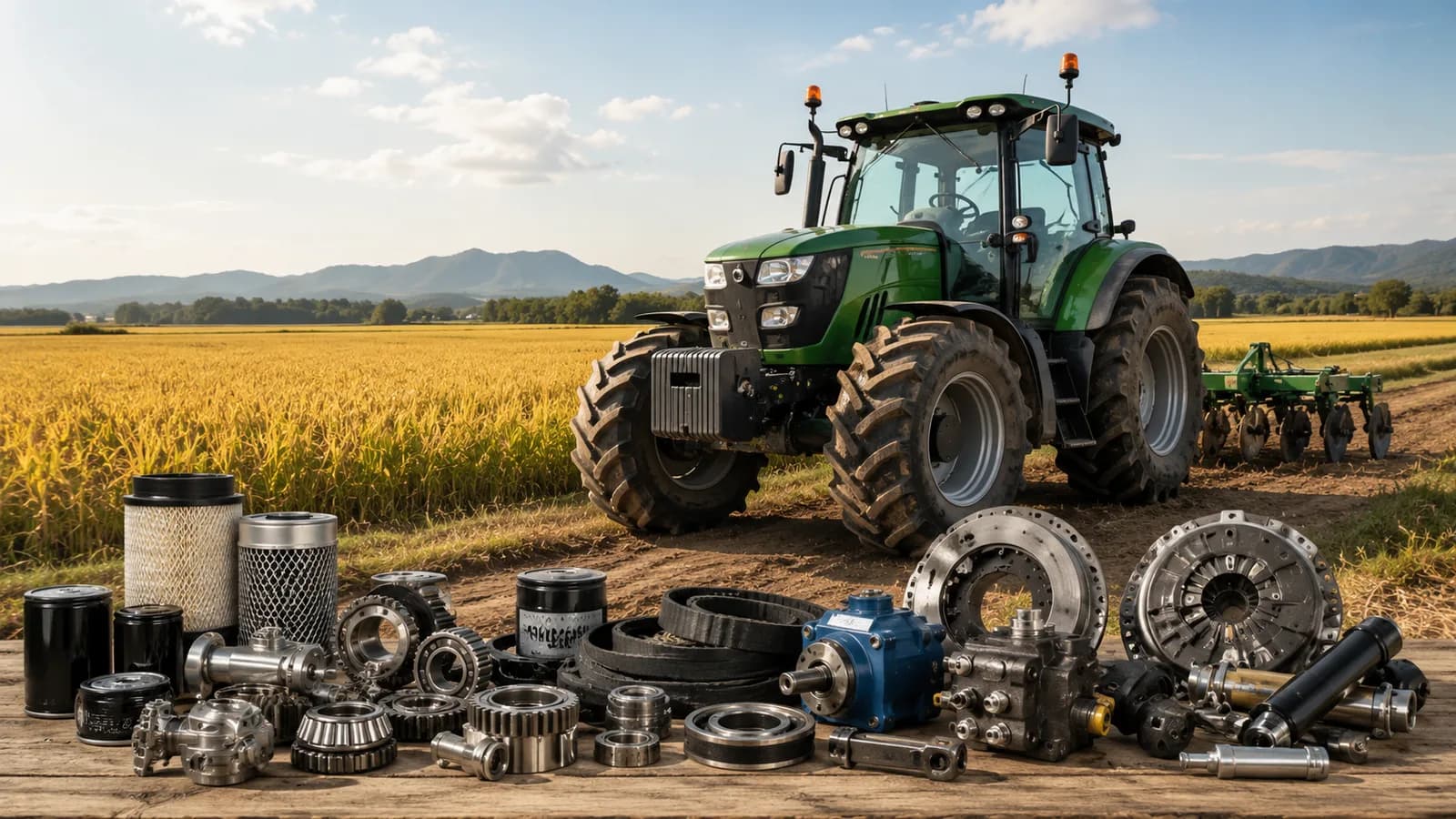
Agricultural machinery spare parts from China: what buyers should check first
Agricultural machinery spare parts from China can be useful for dealers, repair workshops, fleet owners, importers, distributors and procurement managers. But tractor spare parts, tiller spare parts, harvester spare parts and farm equipment replacement parts must be verified carefully before ordering. A part can look correct in a photo and still fail because the engine version, transmission variant, shaft spline, mounting hole, seal material, bearing type or hydraulic specification is different.
MAVORIX INDUSTRIAL supports Agricultural Equipment sourcing and industrial spare parts sourcing from China. Our role is sourcing coordination and risk reduction, not claiming that every supplier or every part is automatically compatible.
This guide explains what overseas buyers should prepare before sourcing agricultural equipment parts from China, how to compare Chinese suppliers, and when supplier verification or quality inspection should be added before shipment.
Typical agricultural spare parts sourcing scenarios
Agricultural spare parts inquiries often arrive in practical, imperfect forms. A buyer may have a broken tractor part, a tiller belt with no readable marking, a harvester wear part from an old machine, or a hydraulic component with only a partial label. Some distributors also send long mixed lists covering filters, bearings, belts, seals, gears, shafts, pump parts, fasteners and workshop consumables.
MAVORIX helps organize these requirements into a clearer RFQ before supplier search. The sourcing path may involve one specialist supplier, several product-category suppliers, or a consolidated order through MRO sourcing from China when the list includes mixed maintenance parts and factory consumables.
Why tractor brand and model alone may not be enough
Agricultural machinery can have variants by production year, engine model, transmission version, regional configuration, supplier update, attachment option and previous repair history. The same tractor model name may not be enough to identify a clutch component, hydraulic pump, belt, seal, gear, shaft, filter or electrical item.
Official parts systems from major machinery brands commonly use model, serial number, diagrams and parts catalogs to identify the correct component. That is a useful lesson for China sourcing: a buyer should send enough machine and part information for suppliers to check the replacement path. When the original part number is not available, photos, dimensions and a sample become more important.
Machine categories need different verification methods
Tractors, power tillers, harvesters, irrigation equipment, farm implements and related agricultural machinery do not use one universal verification method. A tractor transmission part may require spline and gear details. A tiller belt may require profile, length and pulley arrangement. A harvester wear part may require material, shape, mounting and working position. An irrigation pump component may require pressure, flow, seal and connection data.
Do not assume that a method used for one machine family applies to every machine. Buyers should organize inquiries by equipment type, machine model and part function.
How to compare agricultural machinery parts suppliers in China
The best supplier is not always the company with the largest catalog or the lowest unit price. Agricultural spare-parts buyers should compare suppliers according to the specific product group, identification evidence and replacement risk.
| Supplier evidence | What the buyer should check |
|---|---|
| Product focus | Whether the supplier regularly handles the relevant tractor, tiller, harvester, hydraulic or wear-part category |
| Identification process | Whether the supplier asks for complete model codes, serial numbers, installed-position photos, dimensions or samples before confirming a match |
| Replacement status | Whether the quotation clearly states OEM, aftermarket, compatible or custom-made supply |
| Technical confirmation | Whether dimensions, material, spline, thread, mounting, pressure or other critical interfaces are confirmed in writing |
| Product evidence | Whether the supplier can provide current product, label, packing or production photos connected to the quoted item |
| Inspection and claims | Whether the quotation defines inspection scope, packing, wrong-part handling and practical claim limitations |
Information buyers should prepare
| Information | Why it matters |
|---|---|
| Exact machine model and production year | Helps narrow the machine variant |
| Engine model and transmission version | Important for filters, belts, clutch, gears, shafts and powertrain parts |
| Serial number where available | Helps distinguish production changes and regional variants |
| Old part number and supplier part number | Useful for cross-checking exact or compatible replacements |
| Photos of the part and installed position | Shows shape, orientation, mounting and connection details |
| Dimensions, sample and material clues | Needed when part numbers are missing or unclear |
| Quantity and destination country | Helps suppliers quote packing, lead time and shipment planning |
What buyers should send before supplier search
Before asking Chinese suppliers to quote agricultural equipment parts, prepare a compact information package:
- Machine brand, model, production year and serial number where available.
- Engine model, transmission version, hydraulic system reference and regional configuration where relevant.
- Old part number, supplier number, casting mark, packaging label or previous invoice reference.
- Clear photos of the old part, nameplate, installed position, mounting face, spline, thread, ports and wear area.
- Key dimensions, material clues, sample availability and whether an exact or compatible replacement is acceptable.
- Quantity, expected repeat demand, urgency, destination country and preferred shipping method.
- Current supplier links, previous quotations or failed replacement notes if available.
Common agricultural spare part categories
Agricultural spare parts sourcing may include filters, bearings, belts, seals, bushings, gears, shafts, clutch-related parts, transmission-related parts, hydraulic-related parts, pump-related parts, wear parts and general maintenance components. These categories are common in real agricultural machinery applications, but each item still requires machine-specific confirmation.
For farm machinery wear parts, material and heat treatment may affect service life, especially where parts contact soil, crop residue, load, impact or abrasion. Do not assume two similar parts are equal without confirming material, dimensions, mounting and working conditions.
OEM, aftermarket and compatible parts
| Part type | Meaning | Useful when | Main caution |
|---|---|---|---|
| OEM part | Original equipment manufacturer reference or supply path | Exact match and machine support are important | Price or availability may not fit the buyer's plan |
| Aftermarket part | Non-OEM part made for replacement use | Common maintenance or wear parts with clear specification | Quality varies by supplier and application |
| Compatible part | Different brand or source intended to match function and interface | Original part is unavailable or buyer accepts alternatives | Compatibility must be verified carefully |
| Custom-made part | Made from drawing, sample or measured specification | Suitable mechanical item is unavailable | Requires engineering approval and inspection |
What to verify by component type
For filters, verify part number, dimensions, thread, sealing surface, filtration type, application, engine model and whether the filter is for oil, fuel, hydraulic or air use. A similar-looking filter may not have the same internal specification.
For bearings, verify bearing designation, bore, outside diameter, width, seal type, load direction, speed, housing fit and working environment. Bearing manufacturers such as SKF publish catalogs using dimensions and design variants, which reinforces the point that a bearing number or dimensions are only part of the confirmation.
For belts, verify profile, length, width, pitch, tooth form where relevant, material, pulley arrangement and application. Belts used in dusty, outdoor or high-load farm machinery may have different requirements from light-duty industrial belts.
For seals, verify inside diameter, outside diameter, width, lip design, material, operating medium, temperature and shaft condition. A seal that fits dimensionally may still fail if the material is wrong for oil, fuel, hydraulic fluid, dust or heat.
For gears and shafts, verify tooth form, module or pitch, spline form, shaft diameter, keyway, length, bearing positions, heat treatment, surface treatment and load. Left/right orientation, mounting holes and connection dimensions can also matter.
For hydraulic-related parts, verify port size, thread, pressure range, flow, valve function, cylinder bore and stroke, seal kit details, hose connection and working medium. Do not approve substitutions for pressure-related items without technical confirmation.
Why visually similar parts can still be wrong
Agricultural machinery parts are often repaired in the field, modified, or replaced with compatible alternatives over time. The part currently installed may not be the original reference. A visually similar gear may have a different tooth profile. A shaft may have a different spline. A filter may fit the thread but not the required filtration performance. A hydraulic valve may have the same body shape but a different function or pressure range.
This is why a quotation should not be approved until the supplier's assumptions are written clearly.
How to prepare a spare-parts RFQ
For a single item, provide machine model, engine model where relevant, part number, photos, dimensions, installed position, quantity and destination country. For a distributor's multi-item inquiry, prepare a table.
| Column | Recommended content |
|---|---|
| Part number | OEM number, supplier number or unknown |
| Description | Practical name and machine position |
| Quantity | Required pieces and repeat demand if known |
| Machine model | Tractor, tiller, harvester or implement model |
| Reference photo | Old part, nameplate, installed position |
| Dimensions | Key sizes, mounting, thread, bore or connection |
| Remarks | Exact, compatible, aftermarket or sample required |
Quality inspection, packing and consolidation
Incoming or pre-shipment inspection should check quantity, labels, dimensions, visible defects, packing condition, surface finish and critical interfaces. For wear or load-bearing components, buyers may need material or heat-treatment confirmation depending on the application. Avoid inventing universal hardness values; requirements depend on the specific part.
Export packing matters because agricultural parts can be heavy, oily, sharp, mixed-size or easy to lose. Use labels, carton marks, pallet protection and separate packing for small parts. When buyers purchase tractor, tiller and harvester parts from several suppliers, container consolidation can help reduce scattered shipments and improve tracking.
Related sourcing paths for agricultural equipment buyers
Agricultural spare parts orders often overlap with other industrial sourcing needs. Buyers may also need factory spare parts sourcing, MRO supplier checks, or mixed order coordination through container consolidation. If the inquiry includes hydraulic pumps, valves, gear pumps or directional valves, see product sourcing references such as Rexroth 4WE6D6X/OFEG24N9K4, DAIKIN V38A3RX-95, and HYTEK HG0-08-01A-VPC.
Practical agricultural spare-parts buying checklist
- Confirm machine model, engine model, transmission version and serial number where available.
- Collect old part numbers, supplier numbers, photos, dimensions and samples where possible.
- Separate OEM, aftermarket, compatible and custom-made options.
- Verify filters, bearings, belts, seals, gears, shafts and hydraulic parts by function and interface.
- Ask suppliers to state assumptions and exclusions in writing.
- Use quality inspection support for higher-risk or first-time orders.
- Plan export packing and labeling before shipment.
- Consolidate mixed spare-parts orders when several suppliers are involved.
Key takeaways
- Tractor brand or model alone may not identify the correct part.
- Engine model, transmission version, serial number and regional variant can affect compatibility.
- OEM, aftermarket and compatible options should be compared by application, not by label alone.
- Visually similar parts may still differ in spline, shaft, seal, material, pressure or mounting.
- A structured RFQ reduces wrong-part risk for agricultural spare parts sourcing.
Soft next step
Send machine model, engine model where relevant, part number, photos, dimensions, quantity and destination country through the contact page. MAVORIX INDUSTRIAL can help review the sourcing path, compare suppliers and coordinate the next steps from China.
Email: michael@mavorixindustrial.com WhatsApp / Phone: +86-13967842747